By Kally Draycott, Coworking Space Co-ordinator & Host
We love hearing about amazing projects and collaborations at Society1. There are so many different types of businesses in our community with such a range of focus.
As part of our Coworker Projects series we caught up with Dr. Priya Silverstein, a research scientist who is passionate about improving the way we do and value research.
Priya became a Society1 member a few months ago and has quickly settled in to the coworking lifestyle. They are an excellent addition to our community who lights up everyone’s day!
This week, I had a chat with Priya to find out more about what they do and why Society1 suits their needs as a workspace.
Society1: First of all, can you tell us about yourself, your background, etc?
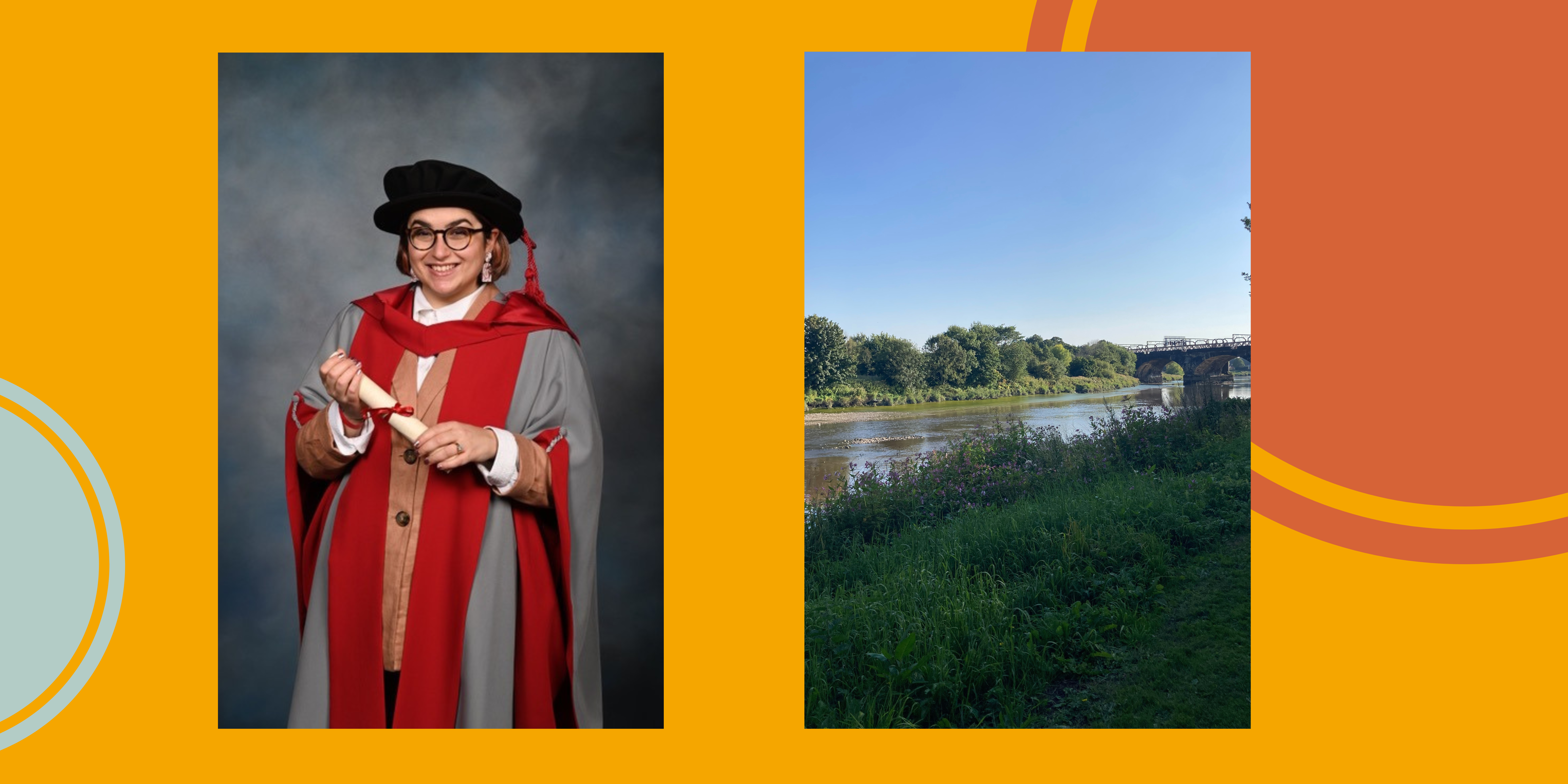
Priya Silverstein: Sure! I was born on a Greek island, but mostly grew up in London. I did my BSc in Psychology and MSc in Cognitive Neuroscience at Aston University in Birmingham, and then moved to Preston when I started my PhD at Lancaster University! My PhD was in developmental psychology — I studied whether babies know that they’re being communicated to when we do things like look them in the eyes, point at stuff, and put on that sing-songy voice that we use with them. But during my PhD I ended up becoming really interested in open science — making the science we do more transparent, open, and inclusive, so this is what I focus most of my time on now.
S1: Why Preston? What is your favourite thing about being based here?
PS: Well I originally moved to Preston because when I got the offer to do my PhD at Lancaster University, my wife and I visited Lancaster we didn’t really like it that much (and it was more expensive). We thought Preston would be close enough for me to commute to Lancaster, but then also easy to get to lots of other places so my wife would have lots of options for jobs. So, originally it was quite a logistical decision but now I’m so glad that we ended up in Preston! I love everything about it — Avenham park, all the lovely independent cafes and restaurants, being close to the Lakes and Manchester, and of course the lack of London prices! Most of all I love the sense of community and how friendly everyone is.
S1: Tell us about a project you’re currently working on.
PS: Currently I’m working on a project called SCORE for the Center for Open Science. We’re assessing the credibility of published social-behavioural science claims and developing methods to better assess credibility. SCORE is creating and validating algorithms to provide confidence scores for research claims at scale. This involves creating a database of claims from papers in the social and behavioural sciences, conducting expert and machine generated estimates of credibility, and collecting evidence of the reproducibility, robustness, and replicability of claims in some of the papers in our database. Because the Center for Open Science is a nonprofit and not an academic institution, I’ve really missed the lab meeting experience from academia, so I’ve also founded my own lab — Nowhere Lab!
S1: What inspired you to start the Nowhere Lab? What do you hope to achieve?
PS: My main motivation was selfish — I just wanted a place to have a weekly check-in with likeminded people and build a sense of community. But I also came across a lot of other people like me, who for some reason needed that sense of scientific community and wasn’t getting that somewhere else. I hoped that it would be a space where people could be themselves, ask for advice, learn stuff, and generally something to look forward to every week. And I think so far it’s achieving that aim!
S1: In your opinion, why is it important for people to have a community or resource such as the Nowhere Lab?
PS: People need community for lots of different reasons — maybe where they currently work doesn’t have a way of building community with colleagues (especially if they’re working predominantly remotely), maybe they’re working in a toxic environment and need some community outside of that, maybe they are working for themselves and therefore are missing having colleagues, or maybe they’re between jobs. Whatever the reason, it seems to be popular — we have over 130 members and an active Slack as well as our weekly meetings with around 5-10 people attending most weeks.
S1: One last question, we have to ask, why do you like working at Society1?
PS: I love working at Society1 because it really makes me feel like a “normal human” again. After working from my home office since March 2020, it’s been really great to work somewhere else among other humans. Just hearing background noises (the tapping of laptop keys, other people having Zoom meetings, the coffee machine) ground me and make me feel like I’m part of something bigger than just my tiny world. It’s a similar feeling to what I get from Nowhere Lab, in fact! Thank you to the Society1 team for creating such a lovely community.
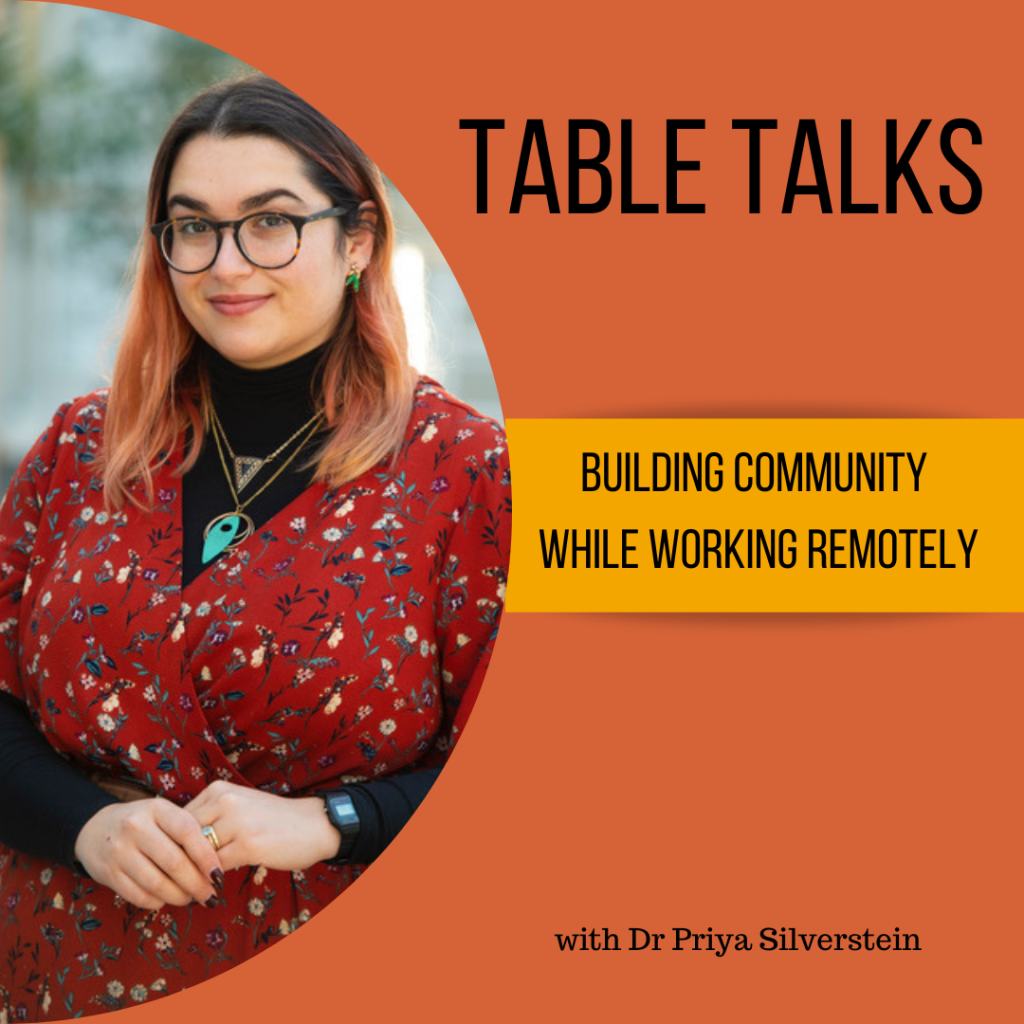
On Tuesday, 13 September, Priya will be leading the first of our Table Talks Events!
Table Talks will be round-table discussion style events, with a set topic and a peer leader each time. These informal discussions will help you broaden your understanding of a variety of topics and issues as well as connect you with your peers.
The first topic is “Creating Community Whilst Working Remotely” and will be led by Priya Silverstein.
If you’d like to connect with Priya, you can find their LinkedIn and the twitter for the Nowhere Lab here: